Where a Perfume Quote Hides Costs: Reading a Price Breakdown
Two quotes for the same brief can differ by a factor of two without either supplier being dishonest. The difference is usually scope: one price includes a stock bottle, a plain cap and a standard carton, while the other includes a custom mould, a decorated cap and a printed box. Comparing perfume quotes therefore means normalising the scope first and the price second, and reading the exclusions as carefully as the numbers.
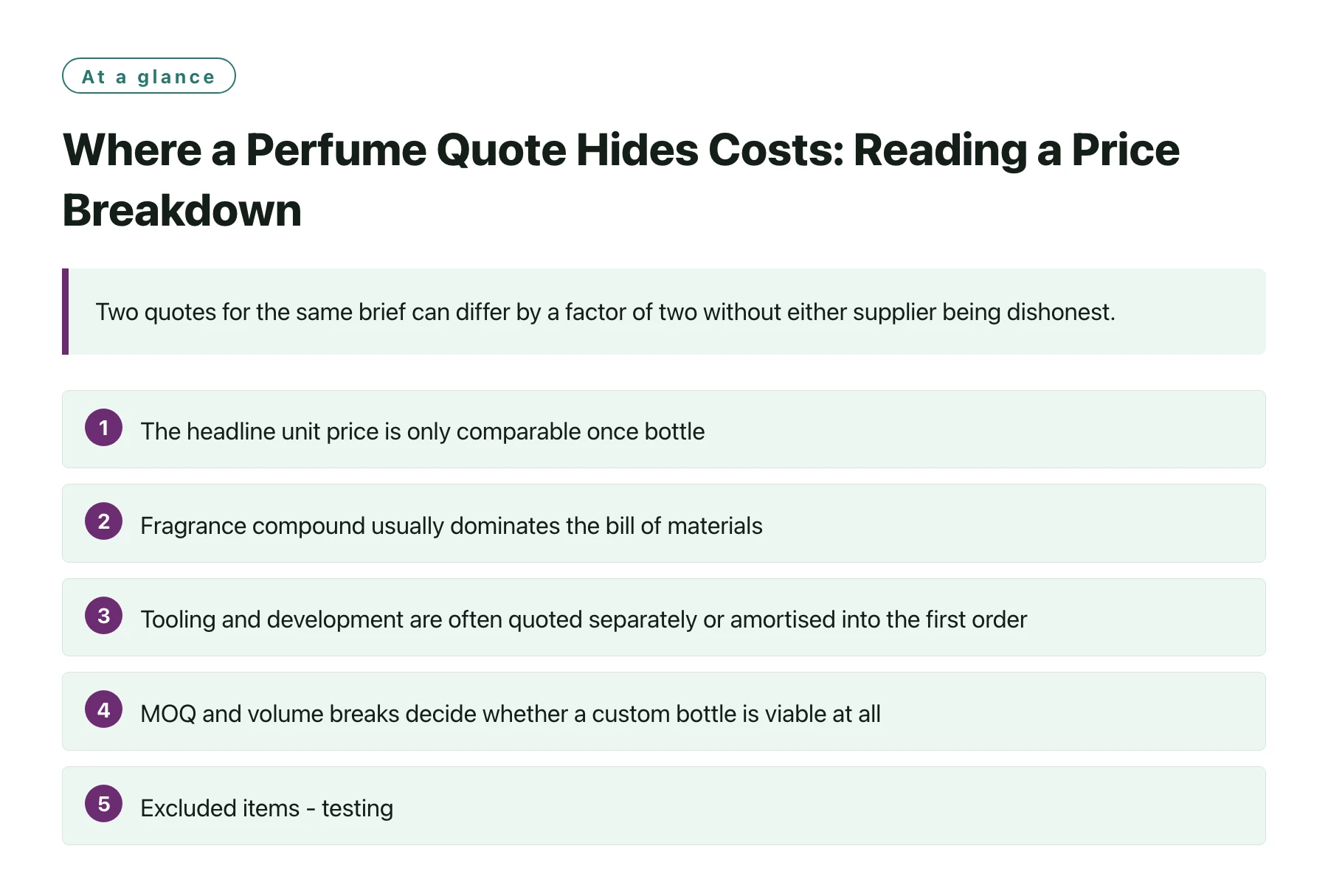
Key takeaways
- The headline unit price is only comparable once bottle, cap, decoration, carton and tooling are all specified at the same level.
- Fragrance compound usually dominates the bill of materials, so any difference in concentration or material grade shows up as a large unit-price gap.
- Tooling and development are often quoted separately or amortised into the first order, which hides the true cost of small volumes.
- MOQ and volume breaks decide whether a custom bottle is viable at all, and they are frequently the quiet reason two quotes look so different.
- Excluded items - testing, documentation, artwork adaptation, freight and payment terms - are where the surprise at invoice stage usually comes from.
Procurement teams tend to compare quotes on the number at the bottom. In fragrance that number is the least comparable element, because the product is assembled from several independently priced parts and most of them can be substituted.
What follows is a way to read a perfume quote that makes the differences visible, whether you are buying a private label line or developing a formula from scratch.
Why two quotes for the same brief rarely match
A perfume product is not one purchase. It is a fragrance compound, a primary pack, a closure, decoration, a secondary pack, a filling operation, testing, and documentation. Each of those can be sourced at different quality and cost levels, and a supplier quoting quickly will fill the gaps with whatever its own standard package contains.
That is not necessarily a problem. It becomes a problem when the brand compares the totals and concludes that one supplier is expensive, when in fact the two quotes describe different products. The comparison only becomes meaningful after both are rewritten to the same specification.
The lines that decide the unit price
| Cost line | What really drives it | The question that exposes it |
|---|---|---|
| Fragrance compound | Concentration plus the cost of the individual aroma materials | What is the compound cost per kilogram, and at what dosage? |
| Bottle or container | Stock mould versus new mould, glass weight, decoration method | Is this an existing mould, and who owns it if we pay for it? |
| Closure and pump | Crimp versus screw, actuator type, metal or plastic finish | Is the pump specified by brand and model number? |
| Decoration | Printing, hot stamping, coating, label application, number of passes | How many decoration steps are included, and what does each extra one cost? |
| Secondary packaging | Rigid box, folding carton, insert, print coverage, material weight | Is the carton priced at the print coverage in our artwork? |
| Tooling and setup | New moulds, print plates, filling line changeover | Is tooling amortised into the first order, and is it billed again? |
| Volume and MOQ | Minimum run for compounding, filling and decoration separately | Which one of those three sets the real MOQ? |
Ask for the quote in this structure and the comparison becomes arithmetic rather than impression. If a supplier will not break the price down, that is itself information about how the relationship will run.
Normalising two quotes in one afternoon
- Fix the specification firstWrite one document listing compound dosage, pack, closure, decoration, carton and documentation, then ask both suppliers to quote against that document and nothing else.
- Separate one-time from per-unitMove tooling, artwork adaptation, sample costs and testing into a one-time column. Fold them back in only when you divide by the actual order quantity.
- Recalculate at your real volumeUnit prices are usually quoted at a convenient volume. Recompute both quotes at your first order quantity and at your twelve-month forecast.
- List the exclusions explicitlyAsk each supplier to state what is not in the price: freight, duties, testing, regulatory documents, storage, artwork changes, downtime for rework.
- Compare payment and lead time lastA deposit-heavy schedule and a longer lead time both carry a working-capital cost that never appears in the unit price.
When a price looks unusually low, look for the substituted part rather than assuming efficiency. It is almost always a lighter bottle, a cheaper pump, fewer decoration passes, a lower dosage, or a run length that the factory can schedule alongside other work. Any of those can be a legitimate choice - but it should be your choice, not a detail you discover on delivery.
The lines that are missing entirely
The most expensive part of a quote is often the part that is not in it. Three categories account for most of the surprises.
Packaging that changes after the quote
Carton and label decisions frequently move after pricing, because artwork is still being designed. Regulatory pressure on packaging is increasing as well: the EU's packaging rules are being revised through the Packaging and Packaging Waste Regulation, which affects material use and recycled content [1]. A quote that fixes packaging cost before the artwork is frozen is a provisional number, and it is worth knowing where a perfume quote can hide costs before you sign against it.
Documentation and testing
Stability testing, compatibility testing, microbiological testing where relevant, and the documentation a destination market requires are sometimes included and sometimes billed per project. Trade coverage of the beauty and personal care supply chain treats these as recurring cost pressure points rather than one-off items [2], and the same titles regularly note how packaging and ingredient costs move faster than retail prices. Ask for the list in writing.
The cost of getting the volume wrong
Forecast accuracy is a cost line. Mintel's press output on beauty and personal care tracks how consumers trade between price tiers in the same category [3], which is a reminder that the retail price ceiling is set by shoppers rather than by the cost sheet. If the first order is too small, unit cost rises; if it is too large, cash sits in inventory. For a line where the fragrance is still being refined, it is worth understanding cost drivers in custom fragrance wholesale before committing to a large opening run.
A short note on private label economics
Private label changes the cost structure rather than the arithmetic. Because the formula is often adapted from an existing base, development cost falls, and the savings can be moved into packaging or into a larger opening order. The trade-off is exclusivity, which has to be negotiated separately and priced separately.
Brands that understand this early treat Xuelei's factory as one line of a sourcing plan rather than as the whole plan: compound from one place, pack from another, filling and assembly wherever the logistics work best. There is nothing wrong with either approach, provided the quote you are comparing is the one that matches the structure you have chosen.
Sources
- European Commission: Packaging Waste and the PPWR —— EU rules on packaging and packaging waste, including the Packaging and Packaging Waste Regulation requirements on recyclability and design.
- Cosmetics Business —— A trade publication covering the beauty and cosmetics industry, including fragrance launches and regulatory developments.
- Mintel Press Centre —— Mintel's press releases on consumer and beauty market research, including fragrance and personal care trend reporting.
Frequently asked questions
Why is a perfume unit price quoted in ranges?
Because several components move with volume. A range usually reflects different order quantities, different packaging choices, or a compound price that is only firm once the formula is fixed.
Should tooling be paid upfront or amortised?
It depends on volume and on who keeps the mould. Amortising lowers the entry cost but obscures the real tooling value; paying upfront is clearer and normally means the brand owns the asset.
How do we compare a quote that includes packaging with one that does not?
Re-specify both to the same pack, closure, decoration and carton, then compare. If the supplier cannot quote your specified pack, ask for the price of the pack separately so you can source it yourself.
What is the most common hidden cost in a fragrance project?
Rework after artwork changes and repeat sample rounds caused by an incomplete brief. Both are process costs rather than manufacturing costs, and neither is visible in a unit price.
How many quotes should a brand collect?
Three against an identical specification is usually enough to see the market range. More than that tends to consume the time the project needs for development.